Hotel & Hospitality TSCM: Guest Privacy Protection & Liability Mitigation for Ontario Resorts, Lodges & Chains (2026)
By Imperial Consulting Unit Inc. · Licensed PI · TSCM Certified
Hotel & Hospitality TSCM: Guest Privacy Protection & Liability Mitigation for Ontario Resorts, Lodges & Chains (2026)
When a guest closes the door to their hotel room, they carry a legally recognized expectation of privacy — an expectation Ontario's common law extends even into commercial hospitality settings. That expectation has been shattered repeatedly since 2023, when international media exposed luxury resort chains operating with dozens of hidden cameras embedded in guest suites. For Ontario's 200-plus registered hotels, resorts, and lodges, and for the thousands of short-term rental operators across the province, those scandals reframed a previously theoretical risk into a regulatory, reputational, and legal liability that now demands a structured operational response. Technical Surveillance Countermeasures — TSCM — is how hospitality operators demonstrate the "reasonable steps" that Ontario innkeeper duty-of-care doctrine requires. This guide covers the full 2026 framework: threat model, detection methodology, operational scheduling, legal exposure, and incident response protocols.
ICUnit's professional office and venue TSCM service extends fully into hospitality settings — hotel suites, executive conference rooms, resort common areas, and back-of-house management offices — using the same calibrated equipment stack deployed in boardroom and law-firm engagements.
Why Hotel Rooms Are High-Value Surveillance Targets: Ontario Innkeeper Duty of Care
Ontario common law recognizes the innkeeper's duty of care as a specific application of the broader occupier's liability framework. An innkeeper — any operator charging for overnight or short-term residential accommodation — must take reasonable steps to protect guests from foreseeable harms occurring on the premises. Courts have treated unauthorized surveillance and the failure to detect it as a recognized category of harm under this duty. A hotel that discovers a concealed recording device in a guest room after the fact, and that cannot produce TSCM inspection records demonstrating proactive due diligence, faces substantial exposure in negligent security and invasion-of-privacy claims.
Under Criminal Code s. 184, wilful interception of private communications without consent carries criminal liability. Where a hotel operator is found to have known about a device and failed to act, or where vendor/staff access controls were sufficiently lax to enable device installation, the operator may face both civil damages and regulatory scrutiny. In 2026, with guest awareness at an all-time high, no hotel insurance underwriter treats an absence of documented TSCM activity as a neutral fact.
Our team at ICUnit — CAF Veteran-led, PSISA-licensed, MESA RF Certified, and TSCM Certified — provides written inspection reports structured specifically for counsel review and insurance documentation.
What the 2023 Hidden Camera Epidemic Revealed About Hospitality Security
In March 2023, an international media investigation confirmed that a luxury resort chain had operated with 47 hidden recording devices distributed across 12 properties, primarily in VIP suites and executive floors. The cascade that followed was instructive: within 72 hours of the first report, TripAdvisor and Google Reviews for the affected properties accumulated hundreds of negative ratings; booking volume dropped measurably within the following quarter; regulatory investigations were opened in multiple jurisdictions; and the chain's liability insurer launched a subrogation inquiry premised on the absence of documented security inspections.
Ontario was not directly implicated in that incident, but the downstream effect on guest behaviour is measurable here. Ontario consumers and corporate travel managers now ask explicitly whether properties conduct regular privacy audits. Executive retreat coordinators — a high-value hospitality segment — increasingly require documented TSCM inspection records before committing group bookings. The 2023 episode created a guest-anxiety baseline that persists into 2026 and shows no sign of subsiding. For Ontario operators, proactive TSCM is now a competitive positioning asset, not merely a reactive safety measure.
Ontario hosts over 200 registered hotel and resort properties with 100-plus rooms, and more than 5,000 short-term rental units listed on major platforms. The province's Innkeepers Act does not enumerate specific technical security standards, which means the "reasonable steps" bar is currently defined by what a prudent operator in the industry actually does — and what plaintiff's counsel can argue the hotel failed to do.
The Ontario Hospitality TSCM Threat Model: Eight Risk Vectors
Generic corporate TSCM threat models do not translate directly to hospitality settings. Hundreds of strangers cycle through a property weekly; vendor and housekeeping access windows are broad and loosely supervised; room technology has expanded to include smart TVs, IoT climate systems, and USB charging infrastructure — each a potential attack surface. The eight primary threat vectors in a hospitality context are:
Corporate Espionage Targeting Executive Retreats & Conference Rooms
Ontario's resort corridor — from the Muskoka lakes to Niagara wine country — hosts a steady volume of high-stakes corporate retreats, M&A strategy sessions, and board offsites. Adversarial intelligence-gathering operations, whether by direct competitors, activist investors, or foreign commercial actors, specifically target these environments because the combination of relaxed security posture and sensitive verbal communication creates high signal yield. Conference rooms, executive boardrooms, and VIP suites booked under corporate names are the primary targets. Pre-meeting TSCM of conference rooms and hospitality suites — scheduled as a same-day deployment the morning of the event — is the operational standard for high-risk gatherings.
Compromised Housekeeping Staff & Vendor Access
Device planting by an inside actor with legitimate access is the most difficult threat to detect after the fact, and the most legally exposing for the operator. Housekeeping staff, third-party maintenance contractors, and construction crews performing room renovations all have unsupervised access to guest rooms during windows when concealment is straightforward. A USB charging cable with embedded optics, a replacement smoke detector with an internal pinhole camera, or a HDMI dongle swapped into the TV port can be installed in under 90 seconds. TSCM inspection protocols post-vendor-access verify that the room state matches its pre-access baseline.
Smart TV, IoT Device Compromise & WiFi Eavesdropping
Modern hotel rooms contain between four and twelve internet-connected devices: smart TV, IP phone, climate controller, digital clock, Bluetooth speaker, and increasingly, voice-activated concierge assistants. Each device represents a potential remote-access vector. Adversaries with brief physical access — or with access to the property's WiFi infrastructure — can load firmware exploits onto smart TVs that silently enable the built-in microphone, redirect streaming stick sessions to exfiltrate viewed content, or spoof the hotel's WiFi SSID to intercept guest device traffic including payment credentials and VPN authentication tokens. A comprehensive hotel TSCM sweep includes a full WiFi and Bluetooth frequency audit in addition to the physical RF sweep.
The remaining five vectors — guest-placed devices targeting neighbouring rooms through shared HVAC and thin partition walls; blackmail and sexual assault predators targeting luxury suite guests; influencer and celebrity guest targeting by paparazzi-adjacent actors; thermal imaging through exterior windows; and pinhole optics embedded in wall art, mirrors, or bathroom exhaust fans — are addressed through the physical inspection and RF detection protocol described in the next section.
Hidden Camera Concealment Points: Where Professional Sweepers Look First
Consumer awareness of "obvious" locations — smoke detectors, alarm clocks — is now sufficiently widespread that sophisticated actors have shifted to lower-profile concealment points. ICUnit's hotel TSCM inspection protocol covers all twelve primary locations:
| Concealment Location | Device Type | Primary Detection Method |
|---|---|---|
| Smoke detector housing | Pinhole camera, microphone | Physical inspection + NLJD |
| Digital alarm clock / radio | Integrated AV recorder | RF scan + physical inspection |
| Wall outlet / USB charging port | Inline power camera | Physical inspection + thermal |
| Picture frame / wall art | Pinhole camera, IR sensor | Lens detection sweep + NLJD |
| Desk lamp or floor lamp base | Integrated AV, GSM transmitter | RF scan + thermal imaging |
| Bathroom exhaust fan | Pinhole camera | Physical inspection + NLJD |
| Sprinkler head housing | Pinhole camera | Physical inspection + lens detector |
| Two-way mirror | Passive optical | Light-extinction test + physical |
| USB charging cable / adapter | Inline camera, keylogger | Physical inspection + thermal |
| Bluetooth speaker | Rogue Bluetooth relay | BT scanner + RF |
| Smart TV / HDMI port | Rogue streaming stick, firmware exploit | Device audit + WiFi scanner |
| Wall-mounted AC unit | Concealed AV recorder | Thermal imaging + physical |
Professional Hotel TSCM Equipment & Multi-Room Scaling Protocols
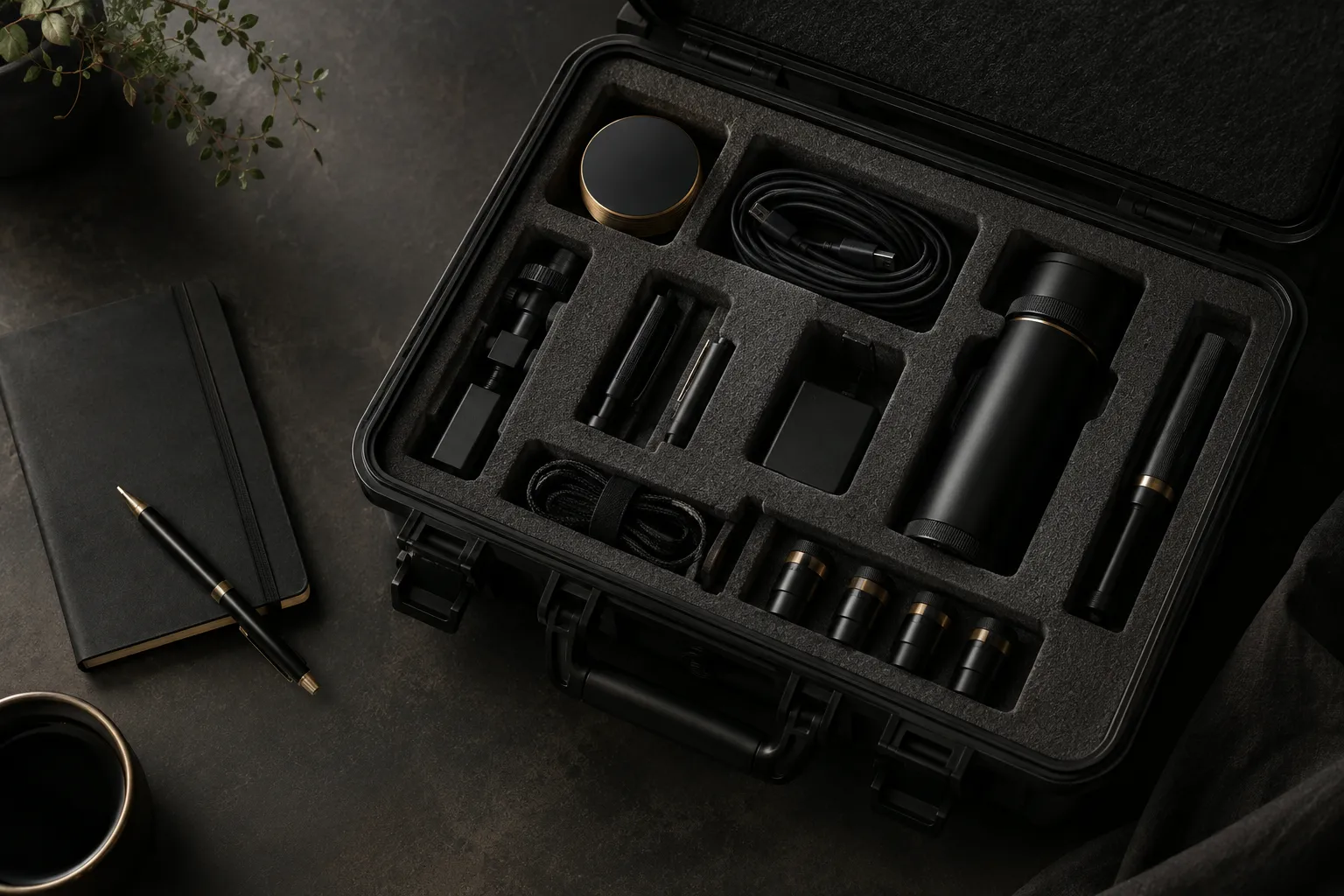
The equipment required for a credible hotel TSCM sweep goes significantly beyond the consumer-grade RF detector available at consumer electronics retailers. A professional deployment uses: an RF spectrum analyzer covering the full 0–2 GHz range for active transmitting devices; a thermal imaging camera to detect the heat signatures of powered recording hardware; a Non-Linear Junction Detector (NLJD) that identifies semiconductor components concealed behind wall panels, furniture voids, and ceiling tiles, regardless of whether the device is transmitting; a USB endoscope for access to ventilation ducts, outlet interiors, and lamp bases; a dedicated WiFi analyzer for rogue access point detection and traffic monitoring; and a Bluetooth scanner for unauthorized pairing and relay identification.
For a deeper explanation of how each instrument works in a professional counter-surveillance deployment, see our TSCM methodology overview. For corporate environments with adjacent concerns — such as executive boardrooms attached to a hotel conference centre — our office TSCM sweep service covers contiguous spaces in a single engagement.
Multi-room scaling is one of the technical challenges unique to hospitality TSCM. A boutique property with under 30 rooms can typically be completed in a single one-to-two-day deployment without significant guest-schedule disruption. A mid-size property (30–150 rooms) requires a floor-by-floor rotation coordinated with the front desk to sequence room availability windows. A large chain or resort (150+ rooms) requires either a phased multi-week deployment or a dedicated retainer model with a rotating inspection team. ICUnit's recurring TSCM membership is specifically designed for multi-property operators who require predictable scheduling, consolidated reporting, and priority same-day emergency response across their portfolio.
The Hotel TSCM Operational Framework: Quarterly Audits, Emergency Sweeps & Pre-Opening Inspections
A mature hospitality TSCM program has four operational modes:
| Property Type | Initial Sweep Scope | Recommended Frequency | Priority Focus Areas |
|---|---|---|---|
| Boutique (under 30 rooms) | Full-property walkthrough | Bi-annual + post-renovation | VIP suites, executive boardroom, owner's office |
| Mid-size hotel (30–150 rooms) | Floor-by-floor sweep | Quarterly | All guest floors, conference rooms, business centre |
| Large chain / resort (150+ rooms) | Phased multi-wing deployment | Quarterly per zone + emergency on-demand | All floors, back-of-house, executive suites, parking |
| Short-term rental / Airbnb | Full unit sweep | Pre-season or post-tenancy | Bedroom, bathroom, living area, all tech devices |
Pre-opening inspections are critical for new builds and renovated properties. Construction crews, subcontractors, and equipment suppliers all have extended unsupervised access to rooms during the build phase — an ideal window for planting hardwired devices in wall cavities or inside permanent fixtures. ICUnit conducts pre-opening TSCM sweeps that include NLJD scanning of all finished walls, ceiling panels, and floor voids before the first guest check-in.
Emergency same-day sweeps are triggered by a guest privacy complaint, a media inquiry, or the discovery of a suspicious device during routine housekeeping. These engagements prioritize evidence preservation alongside device detection and are conducted with legal-hold protocol to support subsequent law enforcement or insurance proceedings. For Toronto and GTA properties, same-day response is standard; properties in the broader Ontario service area — including Niagara Falls resort corridor and destinations across the province — are served via mobile deployment.
ICUnit's TSCM bundle package allows hospitality operators to combine venue and vehicle sweeps in a single engagement — relevant for executive retreat properties where the security perimeter includes guest vehicle drop-off areas and parking structures.
For corporate retreat bookings, a pre-meeting sweep of the conference room and VIP suites — typically conducted the morning of the event — is a separate, priority-scheduled engagement available through ICUnit's recurring membership or as a standalone request via confidential consultation booking.
Ontario Innkeeper Liability, Brand Reputation Risk & Insurance Implications
The legal exposure framework for Ontario hotel operators has three interlocking components. First, civil liability under the tort of invasion of privacy: Ontario courts have recognized a common-law privacy tort that allows guests to seek damages where a hotel's failure to take reasonable protective steps contributed to an unauthorized recording. The damages in individual cases can be substantial, and where multiple guests are affected by a single device or pattern of negligence, class certification risk escalates significantly.
Second, negligent security: where a plaintiff can demonstrate that a security failure enabling the device installation was foreseeable and that the hotel took no documented steps to audit or detect it, the negligent security claim survives even if the hotel was not the direct installer. Expert witness testimony on industry TSCM standards — a service ICUnit provides — addresses what a "reasonable hospitality operator" would have done. See our corporate espionage warning signs guide for the documentation framework that supports negligent security defence.
Third, insurance implications: most commercial innkeeper and hospitality liability policies include a negligent security exclusion or sub-limit that activates when the insurer can demonstrate the operator failed to take reasonable protective measures. TSCM inspection reports — dated, signed by a PSISA-licensed operator, and retained as part of the property's security file — constitute the primary documentary evidence of due diligence in the event of a claim. Some underwriters are beginning to offer premium reductions for properties that produce annual TSCM audit certificates. Operators without documentation face claim denial, not merely claim dispute.
Brand reputation risk is the fourth financial exposure that does not appear on an insurance schedule but materially affects enterprise value. A single public disclosure of a hidden camera discovery cascades through review platforms within 48 to 72 hours. Recovery timelines — restoring review scores and occupancy rates to pre-incident levels — typically span 12 to 24 months, representing a loss of revenue and goodwill that dwarfs the cost of a recurring TSCM program.
Staff Training, Vendor Vetting & Guest Communication Strategy
Technology detection resolves the immediate risk; process controls prevent recurrence. ICUnit's hotel TSCM engagements include a staff awareness briefing covering three areas. For housekeeping, the briefing addresses what anomalous items look like — replacement fixtures that don't match the room's existing hardware, unfamiliar cables behind entertainment units, unfamiliar USB adapters in power strips — and establishes a reporting pathway that reaches the security manager rather than the front desk. For security and maintenance, the briefing covers post-vendor-access verification protocols and the documentation requirements that must accompany any third-party contractor room entry. For front desk and management, the protocol addresses guest privacy complaints — how to take a first report, what not to disturb, and when to call ICUnit for an emergency sweep.
Vendor vetting is the structural control layer. Background-check requirements for housekeeping subcontractors and construction crews, access-log systems that timestamp every key card or manual-access room entry, and a post-renovation TSCM verification requirement written into contractor scope of work collectively reduce the attack surface. See our office bug sweep guide for the vendor control checklist that translates directly to hospitality settings.
Guest communication strategy post-TSCM certification is an underutilized competitive differentiator. A privacy statement in the room information folder — noting that the property conducts regular professional TSCM inspections — addresses the elevated guest anxiety documented since 2023 without creating additional liability. A "privacy-forward" positioning in corporate booking materials appeals directly to executive retreat coordinators and travel managers who are now explicitly screening for documented security protocols.
Incident Response: Evidence Preservation & Legal Coordination Post-Discovery
When a device is found — whether by a guest, housekeeping, or the ICUnit sweep team — the response protocol determines whether the operator's liability exposure contracts or expands. The correct sequence: do not remove or disturb the device until it has been photographed in situ with timestamps and GPS metadata; call ICUnit's mobile team for an immediate supplementary sweep of adjacent rooms on the same floor; notify the property's legal counsel before notifying the guest or media; contact Ontario Provincial Police or local law enforcement for a criminal investigation file number; initiate the insurance claim process with the TSCM inspection report as the opening exhibit; and prepare a written guest notification for review by counsel before delivery. A rushed or undocumented response — one in which the device is disposed of or the guest is notified before legal and forensic documentation is secured — routinely converts a defensible liability position into an indefensible one.
ICUnit's written post-sweep reports are structured for chain-of-custody compliance and are designed to accompany police reports, insurance submissions, and expert witness packages. Book a confidential consultation to discuss response protocol planning before an incident requires it.
Why Choose ICUnit for Hotel & Hospitality TSCM in Ontario?
ICUnit is led by a CAF Veteran holding a PSISA-licensed Private Investigator designation under Ontario's Private Security and Investigative Services Act, 2005, MESA RF Certification, and formal TSCM Certification. The combination of regulated licensure, instrument-calibrated methodology, and written documentation distinguishes a professional hospitality TSCM engagement from the consumer-grade "hidden camera detector" products that hotel security managers sometimes deploy internally. Pricing is custom — quoted privately after a confidential consultation — and structured to reflect property size, engagement frequency, and report format requirements.
ICUnit is mobile across Ontario. Hospitality clients in Toronto and the GTA receive same-day scheduling priority; resort properties in Niagara, Barrie, Ottawa, Hamilton, Kitchener-Waterloo, and Kingston are served via scheduled mobile deployment.
"We'd had a guest complaint in 2026 that we couldn't verify one way or another. ICUnit swept the entire third floor inside four hours — clean report, every room documented — and we had something concrete to show our insurer and the guest's counsel within 24 hours. Exactly the outcome we needed."
— General Manager, 78-room boutique hotel, Yorkville, Toronto (2026)
ICUnit TSCM Service Area: Ontario Hotels, Resorts & Short-Term Rentals
ICUnit provides hospitality TSCM across the full Ontario service corridor: Toronto, Mississauga, Brampton, Vaughan, Markham, North York, Etobicoke, Aurora, Newmarket, Barrie, Hamilton, Oakville, Burlington, Ottawa, London, Kitchener-Waterloo, Kingston, Niagara Falls, and surrounding regions. Multi-property chains across the province are served under a single recurring TSCM membership with consolidated reporting.
Frequently Asked Questions: Hotel TSCM, Guest Privacy & Ontario Innkeeper Rights
Are Ontario hotels legally required to conduct TSCM sweeps for hidden cameras?
There is no Ontario statute that explicitly mandates TSCM sweeps. However, Ontario innkeeper common law establishes a duty of care requiring "reasonable steps" to protect guest privacy. Courts and insurers assess compliance based on what a prudent operator in the industry actually does. As TSCM becomes a documented industry standard practice — driven by the 2023 international hidden camera scandals — a hotel that has no inspection history becomes increasingly exposed in negligent security litigation. The practical legal answer in 2026: TSCM is not mandatory by statute but is increasingly necessary to satisfy the "reasonable steps" standard that governs innkeeper liability.
How often should an Ontario hotel conduct professional TSCM sweeps?
The recommended frequency depends on property size and risk profile. Boutique properties under 30 rooms should conduct a full-property sweep at minimum bi-annually, with an additional inspection after any renovation or third-party contractor access. Mid-size properties (30–150 rooms) should sweep quarterly, floor by floor, with emergency same-day response capacity. Large chains and resort properties with 150 or more rooms benefit from a zoned quarterly rotation on a recurring membership model that also covers priority emergency response. All categories should add a pre-opening sweep before first guest occupancy and a post-renovation inspection before rooms re-open after construction access.
What equipment does a professional hotel TSCM sweep actually use?
A credible hotel TSCM deployment uses a professional RF spectrum analyzer (covering at minimum 0–2 GHz) for active-transmitting device detection, a thermal imaging camera for heat-signature identification of powered concealed hardware, a Non-Linear Junction Detector (NLJD) for semiconductor detection in walls and furniture regardless of transmission activity, a USB endoscope for confined-space inspection, a WiFi spectrum analyzer for rogue access-point and deauthentication-attack detection, and a Bluetooth scanner for unauthorized pairing. Consumer "bug detectors" sold online typically cover a narrow RF band only and produce false positives from legitimate hotel electronics. The NLJD component is the critical differentiator — it finds powered-off hardwired devices that a consumer detector misses entirely.
What should a hotel do immediately if a hidden surveillance device is discovered?
The correct sequence: do not remove or disturb the device; photograph it in place with timestamped images before any handling; contact ICUnit or your TSCM provider for an immediate sweep of adjacent rooms; notify legal counsel before notifying the guest or any media inquiry; contact Ontario Provincial Police for a criminal investigation file number; and initiate the insurance claim process using the sweep report as the primary exhibit. A device that is removed without documentation, or a guest who is notified before forensic and legal steps are taken, routinely converts a defensible liability position into an indefensible one. Incident response planning — before an event occurs — is available via a confidential consultation with ICUnit.
Does regular TSCM documentation reduce a hotel's insurance liability exposure?
Yes, in two ways. First, most commercial innkeeper and hospitality liability policies include negligent security exclusions that activate when the insurer can demonstrate the operator failed to take reasonable protective measures — TSCM inspection records are the primary rebuttal evidence. Second, some underwriters in 2026 are beginning to offer premium adjustments for properties that produce annual TSCM audit certificates, treating documented inspections similarly to fire safety inspection compliance. A hotel without any TSCM documentation faces the risk of claim denial rather than merely a disputed settlement amount. The PSISA-licensed inspection reports ICUnit provides are structured for insurance submission.
Can short-term rental hosts in Ontario benefit from professional TSCM sweeps?
Yes. Ontario short-term rental (Airbnb) operators face the same invasion-of-privacy tort exposure as hotel innkeepers if a guest discovers a device — whether planted by a prior guest, a contractor, or a property co-owner. Platform terms of service (Airbnb's explicit ban on undisclosed cameras) create additional contract liability beyond the civil tort. An ICUnit sweep of a short-term rental unit provides documented evidence that the operator took affirmative steps to verify the unit was device-free before each guest season or high-occupancy period. This documentation matters both for platform dispute resolution and for any civil or criminal proceeding. Pricing is custom — quoted privately after a confidential consultation.
Stay Connected
Follow the ICUnit field log on LinkedIn for new Ontario threat intelligence and hospitality security updates, and read our Google reviews from past sweep clients across the province.
Get Your Free Quote Today
Ontario hotels, resorts, and short-term rental operators: protect your guests, your brand, and your innkeeper liability position with a documented professional TSCM inspection. ICUnit is mobile across Ontario, PSISA-licensed, and issues written reports structured for legal and insurance use. Pricing is custom — quoted privately after a confidential consultation.