Hybrid Work Home Office TSCM: Employee Privacy Protection & Employer Compliance Guide (2026)
By Imperial Consulting Unit Inc. · Licensed PI · TSCM Certified
Hybrid Work Home Office TSCM: Employee Privacy Protection & Employer Compliance Guide (2026)
The Hybrid Work Privacy Crisis: Why Home Offices Are Now Prime Surveillance Targets
Ontario's shift to hybrid work did not just redistribute where employees sit — it redistributed surveillance risk into spaces where Canadians have the strongest expectation of privacy: their homes. In a corporate boardroom, everyone understands the space is monitored, access-controlled, and swept periodically. In a spare bedroom converted to a home office, that protective infrastructure simply does not exist.
The result is a surveillance blind spot affecting more than 500,000 Ontario hybrid workers in 2026. Video calls that carry merger negotiations, client files, salary discussions, and medical information now pass through residential WiFi networks, consumer-grade routers, and rooms shared with smart speakers that are always listening. Every one of those layers is a potential intercept point — and almost none of them are inspected.
This guide addresses both sides of that equation. If you are a hybrid employee concerned about your privacy, you will find the threat model, your legal rights under the ESA, PIPEDA, and the Charter, and a clear description of what a professional home office TSCM sweep detects. If you are an HR professional or employer navigating ESA Section 65 compliance, you will find the written-policy framework, the March 1 annual deadline, and the employer-side compliance audit your legal counsel is likely already recommending. For foundational background on the field, read our primer: What is TSCM? Technical Surveillance Countermeasures Explained.
Ontario RTO Mandate 2026 — What Changed for Hybrid Workers and Their Privacy
Ontario's January 2026 return-to-office directives — covering provincial public sector workers and cascading through enterprise and mid-market employers — created an unusual privacy paradox. Employees who had spent two or three years working entirely from home now split their week between a monitored corporate environment and an effectively unmonitored residential one. Employers who had invested heavily in endpoint monitoring tools during the full-remote period found those tools still running on company laptops that employees now bring home three days a week.
The January 2026 RTO mandate did not pause monitoring software. Keyloggers, screen-capture agents, and activity-tracking applications deployed during 2020–2024 remote-work periods continue operating in home environments — in many cases without an updated written disclosure policy covering home-office monitoring scope. That gap between monitoring practice and ESA disclosure obligation is where legal liability accumulates for employers and where privacy violations occur for employees.
Simultaneously, the physical security picture at home worsened. Post-RTO furniture purchases — second-hand desks, monitors, lamps, and shelving bought to equip permanent home offices — brought new hidden-camera risk vectors into residential workspaces. ICUnit field teams across Toronto and the broader GTA documented a measurable increase in client consultations from hybrid workers during the first quarter of 2026, the majority triggered by RTO-adjacent anxiety about both employer monitoring and third-party physical device threats.
Home Office Threat Model: Eight Active Surveillance Vectors Every Hybrid Worker Should Understand
Generic TSCM guides describe threats designed for corporate boardrooms. Home offices present a distinct profile — smaller perimeter, more IoT devices, less physical access control, and a mixed personal-professional use pattern that creates unique intercept opportunities. The following eight vectors represent the current operational threat landscape for Ontario hybrid workers in 2026.
Technical Threats: WiFi, Smart Devices, Network Hijacking & Fiber-Optic Hybrids
WiFi eavesdropping on video calls. A passive attacker within range of your residential network — a neighbor, someone parked outside, or a device already on your network — can intercept unencrypted or weakly encrypted video-call metadata, sometimes audio, using tools available in consumer electronics. A WPA2 network with a guessable password provides minimal protection against a motivated listener with a directional antenna and a laptop. Man-in-the-middle (MITM) attacks on home networks can redirect traffic even when SSL is indicated in the browser bar.
Smart home device compromise. Amazon Alexa, Google Home, Apple HomePod, and Ring doorbell devices maintain persistent microphone activity by design. Default wake-word detection means the device is processing ambient audio constantly. Firmware vulnerabilities — documented in multiple CVE advisories through 2025 and 2026 — allow persistent unauthorized access that survives factory resets performed without reflashing firmware at the chip level. A smart speaker placed in a home office doubles as a continuous audio monitor when compromised.
Network hijacking and rogue access point spoofing. A rogue WiFi access point broadcasting an SSID identical or similar to your home network — deployed from a vehicle, adjacent unit, or pre-planted device — can capture all traffic from devices that auto-connect. In multi-unit buildings across Ottawa, Hamilton, and the GTA, this vector requires no physical entry to your home. ICUnit WiFi audits use spectrum analysis tools to identify rogue SSIDs, detect de-authentication attack signatures, and map every device currently associated to your network.
Fiber-optic cable microphone hybrids. This emerging class of device embeds a microphone transducer within standard-gauge network or power cabling. The device appears visually identical to legitimate infrastructure, requires no independent power source, and transmits audio via conducted signal along the cable run — detectable only with a cable-anomaly scanner or NLJD sweep of the cable infrastructure. Pre-installed in delivered furniture or passed off as a "cable management" gift, these devices represent the highest-sophistication end of the residential threat model.
Physical and Human Threats: Hidden Cameras, Parabolic Microphones & Employer Software
Hidden cameras in second-hand or delivered furniture. Post-RTO home office buildouts drove a spike in second-hand desk and shelving purchases in 2025–2026. A camera module smaller than a pinhead can be embedded in a lamp, bookend, smoke detector housing, desk clock, or picture frame and transmit wirelessly to a receiver up to 300 metres away. Furniture purchased through marketplace platforms or delivered by courier with tampered packaging presents real risk — particularly for employees handling sensitive commercial or legal information. Our prior analysis of corporate espionage indicators applies directly to this vector: 5 Signs Your Office May Be Bugged.
Neighbor parabolic microphone and laser microphone through windows. A parabolic or laser microphone positioned from an adjacent building or a vehicle with line-of-sight to a home office window can capture conversation with clarity at distances exceeding 100 metres. Glass vibrates with ambient sound; a laser reflected off the pane and returned to a receiver reconstructs audio with minimal signal processing. This threat does not require physical access to your property — it requires only a clear sight line and a patient adversary. Thermal imaging of the window from outside reveals occupant heat signatures and can confirm work-from-home patterns for targeting.
Device planting by household members or visitors. Unlike a corporate building with access logs and badge readers, a home receives family members, delivery personnel, contractors, and neighbors without systematic monitoring. A device planted by a household member during a custody dispute, by a former business partner, or by a contracted tradesperson requires no technical sophistication — consumer recording devices the size of a USB flash drive sell widely and can record continuous audio for up to 72 hours before requiring a charge cycle.
Employer remote monitoring software. This is the threat most hybrid workers in 2026 are actively concerned about — and the one with the clearest legal framework. Keyloggers, screen-capture tools, idle-time monitors, email scanning agents, and GPS geolocation on company-issued laptops may be operating during home-office hours. Whether that monitoring is lawful depends entirely on whether your employer has issued a written electronic monitoring policy that explicitly covers home-office monitoring scope. If they have not, the monitoring may violate ESA Section 21.1.4 and PIPEDA — and a professional TSCM consultation can help you identify what is running on your device and what your legal escalation options are.
ESA Section 65 Employer Monitoring Compliance — What Ontario Employers Must Disclose in 2026
Ontario's Employment Standards Act electronic monitoring provisions, codified in Sections 21.1.4 through 21.1.9, impose specific written disclosure obligations on Ontario employers with 25 or more employees. The obligations do not prohibit monitoring — they require transparency about it.
Written Policy Requirements: What the Compliance Checklist Includes
A compliant ESA electronic monitoring policy must specify: (a) whether employees are monitored electronically, and if so, how; (b) what devices or systems are subject to monitoring; (c) the purposes for which monitoring information is collected and how it will be used; and (d) whether home-office devices, home networks, or location data during remote-work hours are within scope. The policy must be distributed to all existing employees within 30 days of creation and to new hires upon commencement. Employers must retain the policy for a minimum of three years.
The annual review deadline is March 1. Employers who fail to maintain an updated, distributed policy — or who monitor home-office employees in ways not covered by the policy — face ESA orders and potential exposure in constructive dismissal proceedings. Employment counsel at firms including Osler and Achkar Law have flagged the home-office disclosure gap as the most common ESA compliance failure seen in the post-RTO landscape.
Home Office Monitoring Scope: The Gap Most HR Teams Miss
The majority of ESA monitoring policies drafted in 2020–2022 specified monitoring of "company devices on company premises." That language did not anticipate hybrid work. In 2026, "company premises" monitoring clauses do not clearly extend to a company laptop operating from an employee's home network — and attempting to extend monitoring to the home network itself (traffic inspection of residential routers) or ambient room audio would require new consent, not a legacy policy update. Employers who want to understand what their current monitoring footprint actually covers — and how to document it compliantly — can request a compliance audit consultation through ICUnit's employer advisory service.
PIPEDA and Charter Rights — Constitutional Privacy Protections for Home-Based Workers
Canada's Personal Information Protection and Electronic Documents Act (PIPEDA) applies to personal information collected by private-sector employers from employees in provinces without substantially similar provincial legislation — which includes Ontario for federally regulated employers and is the operative federal standard for privacy analysis.
PIPEDA Schedule 1, Principle 4.3 (consent) requires that collection of personal information occur with the knowledge and consent of the individual. When an employer extends monitoring software to a home-office device, captures keystrokes or screen images in a residential environment, or logs network traffic on a personal router, the consent framework from a standard employment contract may not adequately cover that collection — particularly given the heightened privacy expectation courts have consistently recognized in residential spaces.
Charter Section 7 (life, liberty, and security of the person) and Section 8 (protection from unreasonable search and seizure) apply directly when government employers monitor home-based public employees. For private-sector workers, Section 8 informs the reasonableness standard applied in privacy tribunal proceedings and civil courts interpreting PIPEDA's "appropriate purposes" limitation. The constitutional principle is clear: the home is the most private space in the legal landscape, and surveillance in that space requires elevated justification regardless of whether the surveilling party is a government agency or a corporate employer.
Employees who discover undisclosed monitoring — or who suspect their home office has been physically compromised — have a documented escalation path: consult a TSCM professional to identify and preserve evidence, consult employment counsel regarding ESA and PIPEDA breach, and file a complaint with the Office of the Privacy Commissioner of Canada if the PIPEDA breach cannot be resolved directly. ICUnit provides written sweep reports formatted for use in tribunal proceedings and civil litigation.
Professional Home Office TSCM: Detection Equipment, Process & What to Expect
A professional home office TSCM sweep conducted by ICUnit follows the same disciplined methodology as a corporate boardroom sweep, adapted for the residential environment. The process has three integrated phases.
RF Spectrum Analysis, NLJD Sweep & Thermal Imaging
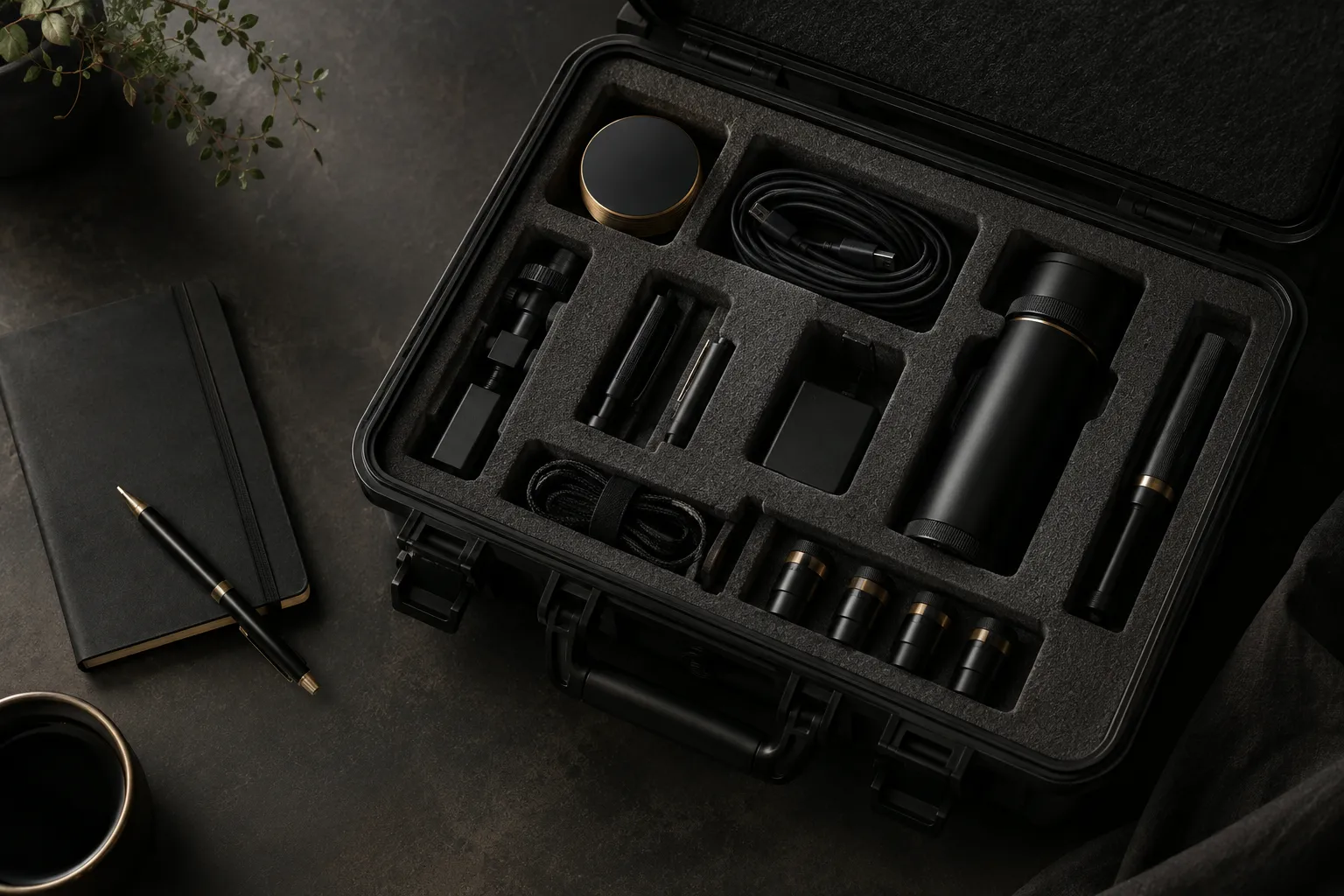
The sweep begins with a broadband RF spectrum scan of the home office and adjacent rooms, using calibrated spectrum analyzers equivalent to MESA-certified equipment. Every signal active in the space is logged — known WiFi SSIDs, Bluetooth, cellular, and any anomalous transmission on frequencies outside normal residential use. A Non-Linear Junction Detector (NLJD) then scans all surfaces, walls, furniture, and fixtures for the semiconductor junctions present in any active or dormant electronic device — including powered-off hidden cameras and microphones not transmitting at the time of inspection. Thermal imaging identifies heat signatures from powered devices concealed behind wall facings, inside furniture cavities, or above drop ceilings.
WiFi Security Audit & Physical Inspection Protocol
The WiFi security audit maps every device associated with the home network, identifies rogue SSIDs broadcasting from nearby sources, checks for de-authentication attack patterns, and tests the network for MITM vulnerabilities. IoT devices (smart speakers, thermostats, doorbells, printers) are individually assessed for known firmware vulnerabilities and anomalous outbound traffic patterns. Smart home devices are evaluated for placement risk in the context of the home office — a Google Nest device in the same room where confidential calls occur represents a different risk profile than one in an adjacent kitchen.
The physical inspection covers every surface and fixture in the home office: desk lamp assemblies, picture frames, power outlets, surge protectors, Ethernet faceplates, smoke detectors, ventilation grilles, and furniture seams. Window surfaces are assessed for laser microphone vulnerability based on sight-line exposure to adjacent properties or street-level positions. Cable runs between rooms are inspected with a cable anomaly scanner for fiber-optic or conducted-signal hybrid devices. A full written report documenting every finding — and every area confirmed clean — is issued within 24 hours of sweep completion.
For clients who want to understand the broader detection methodology used across all ICUnit services, our complete office sweep guide provides additional technical detail: Office Bug Sweep Detection: Complete Counter-Surveillance Guide for Toronto Businesses (2026).
Employer TSCM Compliance Audit — ESA Documentation & Evidence Preservation
ICUnit's employer-facing service addresses a different set of risks: the employer who suspects an employee or competitor has planted listening devices in shared office space or collaborative work areas, and the employer who needs a documented counter-surveillance baseline for ESA compliance reporting, insurance underwriting, or board-level risk governance.
The employer compliance audit includes a full TSCM sweep of all meeting rooms, executive offices, server rooms, and connected collaboration spaces; a WiFi security audit of the corporate network perimeter; a review of existing ESA electronic monitoring policy language against current home-office monitoring practices; and a written compliance report suitable for submission to legal counsel, insurance carriers, or external auditors. Employers in Ontario's regulated industries — financial services, healthcare, legal, and government contracting — increasingly require this documentation as part of annual security certifications. Our office and vehicle bundle package extends the same disciplined sweep methodology to executive vehicle fleets, which remain a surveillance vector for corporate leadership teams operating in a hybrid-work context.
ICUnit is also positioned to provide expert witness testimony in ESA enforcement proceedings and employment tribunal cases where the presence or absence of unauthorized monitoring is a material fact. Pricing is custom — quoted privately after a confidential consultation.
Home Office TSCM Service Coverage Across Ontario
ICUnit is mobile across Ontario, providing home office TSCM sweeps without additional travel surcharge across the following service areas:
| Region | Cities Served | Typical Hybrid Worker Profile |
|---|---|---|
| Greater Toronto Area | Toronto, Mississauga, Brampton, Vaughan, Markham, Scarborough, North York, Etobicoke | Finance, legal, tech, media — high-density, multi-unit building exposure |
| Durham / York Region | Ajax, Pickering, Whitby, Oshawa, Richmond Hill, Newmarket, Aurora | Manufacturing, logistics, provincial public sector — post-RTO commute reduction |
| Hamilton / Niagara | Hamilton, Niagara Falls, St. Catharines | Healthcare, post-secondary, border-adjacent corporate operations |
| Ottawa / Eastern Ontario | Ottawa, Kingston, Barrie | Federal government contractors, defence, intelligence — elevated monitoring risk |
| Southwestern Ontario | London, Kitchener-Waterloo | Tech scale-ups, insurance, academic research — IP-sensitive hybrid roles |
All sweeps are conducted by ICUnit personnel — no subcontractors. Scheduling is discreet; ICUnit vehicles do not carry exterior branding. For same-day consultation inquiries, request a confidential consultation by phone or through the secure intake form.
"I found out through a conversation with a colleague that my employer had been logging every keystroke on my home laptop for eight months without telling me. ICUnit swept my home office in North York in February 2026, confirmed a second device I hadn't planted myself, and gave me a written report my employment lawyer used directly in the tribunal filing. I cannot overstate how important the documentation was."
Why Choose ICUnit for Hybrid Work Counter-Surveillance in Ontario?
The qualifications that distinguish an effective TSCM provider from a general private investigator matter significantly in a home office context, where the threat model blends technical network security, physical device detection, and legal evidence standards simultaneously. ICUnit's founding operator brings a credential set rare in the Ontario market: Canadian Armed Forces Veteran, Licensed Private Investigator under Ontario's PSISA Act 2005, MESA RF Certified, and TSCM Certified. The PSISA Act 2005 governs all licensed private investigation activity in Ontario — including TSCM sweeps — and mandates that sweep operators carry active licensure and maintain professional standards.
The MESA RF certification covers the specific frequency-domain competencies required to distinguish legitimate household RF activity from covert transmission devices — a skill that separates certified operators from technicians using uncalibrated consumer detectors purchased online. ICUnit's recurring TSCM membership provides quarterly scheduled home office sweeps with priority response between cycles, designed for hybrid workers who handle sensitive information as a matter of course and for employers who need a documented sweep cadence for compliance reporting.
Unlike providers who subcontract sweeps to unlicensed technicians or who operate without written reporting protocols, ICUnit provides a documented chain of custody from initial client intake through device discovery to final written report — the same standard required for evidence admissible in Ontario courts and employment tribunals.
FAQ: Home Office TSCM, ESA Compliance & Hybrid Worker Privacy Rights
What is a home office TSCM sweep and what does it detect?
A home office TSCM sweep is a professional counter-surveillance inspection using calibrated RF spectrum analyzers, Non-Linear Junction Detectors (NLJDs), thermal imagers, and WiFi security tools. It detects hidden microphones, covert cameras, rogue WiFi access points conducting man-in-the-middle attacks, compromised smart home devices, cable taps, fiber-optic microphone hybrids, and any unauthorized electronic device transmitting your conversations or data. A written report is issued after every sweep for legal or insurance use.
Does ESA Section 65 apply to home offices in Ontario?
Yes. Ontario's ESA Sections 21.1.4–21.1.9 require any Ontario employer with 25 or more employees to maintain and distribute a written electronic monitoring policy. That policy must disclose whether monitoring extends to home-office environments during remote work periods. Employers who monitor home-based employees without written disclosure face ESA liability and potential constructive dismissal exposure. The annual compliance review deadline is March 1.
How does PIPEDA protect my privacy when I work from home in Ontario?
PIPEDA Principle 4.3 (consent) and Principle 4.7 (safeguards) apply to personal information an employer collects from a home-based employee. Courts recognize a heightened residential privacy expectation. Employers who install monitoring software on home-office devices without explicit informed consent may violate PIPEDA. Employees have the right to access their collected data and request correction under PIPEDA Section 8.
Can my employer legally monitor my home network when I work remotely?
Employers may monitor company-owned devices with disclosed ESA policy coverage. They cannot extend monitoring to personal devices, personal routers, or household networks without explicit consent. Monitoring home routers or ambient room audio without disclosure violates ESA Section 21.1.4 and PIPEDA, and may engage Charter Section 8 protections where state action is involved.
What are the most common surveillance threats in a home office in 2026?
The eight most active vectors are: (1) WiFi eavesdropping on video calls; (2) hidden cameras in second-hand furniture; (3) compromised smart home devices; (4) device planting by household members or visitors; (5) neighbor parabolic or laser microphone through windows; (6) employer-installed keyloggers and screen-capture agents; (7) rogue WiFi access points spoofing legitimate SSIDs; and (8) fiber-optic cable microphone hybrids in network cabling.
How often should a hybrid worker get a home office TSCM sweep?
Schedule a sweep whenever your threat context changes — after a disputed employment situation, receipt of second-hand furniture, unauthorized entry, legal dispute, or newly sensitive project assignment. ICUnit's quarterly membership provides scheduled coverage with priority response between cycles. Pricing is custom — quoted privately after a confidential consultation.
What evidence should I preserve if I discover unauthorized surveillance in my home office?
Do not remove or tamper with the device — you will compromise forensic value. Photograph it in situ, record the time and circumstances, and contact a licensed TSCM operator immediately. ICUnit issues written forensic reports suitable for Ontario employment tribunals, civil court, or police investigation, with full chain of custody documentation from discovery through removal.
Stay Connected
Follow the ICUnit field log on LinkedIn for current Ontario hybrid work threat intelligence, ESA compliance updates, and TSCM case studies — and read our Google reviews from past sweep clients across the province.
Get Your Free Quote Today
Whether you are a hybrid worker in Toronto concerned about home office privacy, or an HR team managing ESA compliance across Ontario locations — ICUnit provides discreet, documented, PSISA-licensed TSCM sweeps with written reports for legal and insurance use.
Call: 905-955-7689 — confidential intake, no obligation.
Or book a confidential consultation online — typical response within two business hours.