Vehicle Counter-Surveillance: Detecting Hidden GPS Trackers After a Break-In (2026 Ontario Security Guide)
By Imperial Consulting Unit Inc. · Licensed PI · TSCM Certified
Vehicle Counter-Surveillance: Detecting Hidden GPS Trackers After a Break-In (2026 Ontario Security Guide)
Your vehicle was broken into. The window is smashed, the console is rifled — but what the police report will not capture is whether someone took something out of your car, or whether they also left something behind. In 2026, Ontario Provincial Police (OPP) and Toronto Police Service (TPS) are actively warning the public about organized break-in rings that use vehicle burglaries as cover to plant AirTags and hardwired GPS trackers — converting a routine theft into weeks of covert surveillance. This guide explains what to look for, how to coordinate with police, and when a professional vehicle TSCM sweep is the only defensible next step.
If you suspect a tracker was planted during a break-in, book a confidential counter-surveillance consultation with ICUnit before you resume normal driving patterns.
Vehicle Counter-Surveillance After a Break-In: Why This Matters in 2026
The 2024–2026 enforcement peak on organized auto-theft rings in Ontario has exposed a disturbing secondary pattern: break-ins are not always crimes of opportunity. OPP organized crime units have documented groups that target specific vehicles — high-value SUVs, commercial vans, executive fleet cars — with a deliberate two-stage operation. Stage one is the break-in itself, used to access interior anchor points for tracking hardware. Stage two is the tracking phase, where the vehicle is monitored for days or weeks until the theft window opens.
The Equite Association, Canada's insurance industry vehicle theft authority, has documented a direct correlation between break-in incidents and subsequent vehicle thefts across Ontario's highest-risk postal codes — including Brampton, Etobicoke, North York, and Scarborough. If your vehicle was broken into in 2026, a professional counter-surveillance sweep is not paranoia. It is operationally sound risk management.
ICUnit provides vehicle counter-surveillance sweeps mobile across Ontario. Our CAF Veteran, PSISA-licensed PI, MESA RF Certified, and TSCM Certified team responds to post-break-in cases in Toronto and across the province, including the Ottawa region.
7 Signs Your Vehicle Was Targeted for Tracking During a Break-In
Not every break-in results in tracker placement, but specific patterns elevate your risk profile significantly. If you identify three or more of the following indicators, a professional sweep is warranted before you drive the vehicle again:
- Nothing of obvious value was taken. A break-in where visible valuables are bypassed is a red flag for a secondary objective such as tracker placement.
- Access was selective or surgical. Only the trunk lid, an undercarriage access panel, or a specific door was disturbed — not the glove box or centre console.
- You drive a high-value or late-model vehicle. Luxury SUVs, commercial fleet vehicles, and new-model trucks are priority targets for tracker-enabled theft rings.
- You are involved in litigation, a contentious business dispute, or a custody matter. Tracker planting is also used for personal surveillance — not only vehicle theft preparation.
- Your battery drains faster than normal since the incident. Some hardwired GPS trackers draw parasitic current from the vehicle's electrical system.
- Your infotainment system behaves erratically — unexpected GPS rerouting, OBD-II warnings, or unrecognized Bluetooth pairing requests that appeared after the break-in.
- You received an AirTag proximity notification on your iPhone or Samsung device following the break-in date.
Where Thieves Hide GPS Trackers Post-Break-In (8 High-Risk Locations)
Professional tracker placement follows predictable patterns based on magnetic surface availability, power source proximity, and RF signal clearance. ICUnit's vehicle GPS sweep service inspects all eight of the following confirmed high-risk locations as a standard post-break-in protocol:
| Location | Common Tracker Type | Detection Method Required |
|---|---|---|
| Wheel wells (all four) | Magnetic GPS puck / AirTag | RF scan + mirror inspection |
| Undercarriage / frame rails | Hardwired GPS / magnetic mount | NLJD sweep + physical access under lift |
| Rear bumper cavities | Magnetic GPS / AirTag | RF analyzer + tactile probe |
| Front bumper / grille cavity | Passive tracker (no real-time signal) | NLJD + physical borescope |
| OBD-II port (dash, driver side) | Plug-in cellular GPS dongle | Visual inspection + RF detection |
| Door seals and interior cavities | Thin magnetic AirTag / passive device | RF sweep + mirror wand probe |
| Fuel door recess | Small magnetic GPS puck / AirTag | Visual + RF scan |
| Brake line and suspension cavities | Hardwired passive tracker | NLJD sweep + lift inspection |
Passive trackers — devices that log location data without real-time transmission — are completely invisible to consumer RF detectors and phone apps. Only a professional NLJD (Non-Linear Junction Detector) scan can identify their semiconductor presence. This is why DIY GPS tracker detection methods have hard technical limits that professional equipment overcomes.
Criminal Code Sections 348, 349 & 184.1: Legal Context for Tracker-Enabled Break-Ins
Ontario break-in victims typically focus on property damage and insurance claims. What is frequently overlooked is the additional criminal liability that attaches when a GPS tracker is discovered — liability that may affect civil recovery, insurance documentation requirements, and police investigation priority and resources.
Section 348 — Break and Enter: Under the Criminal Code of Canada, break-and-enter with intent to commit an indictable offence carries penalties up to life imprisonment. If the intent of the break-in was tracker placement for vehicle theft preparation or personal surveillance, the perpetrator faces enhanced charges beyond simple mischief. A professional sweep report documenting tracker placement gives OPP investigators prosecutorial ammunition that a basic police report cannot provide.
Section 349 — Being Unlawfully in a Dwelling-House: The definition of breaking instruments under Section 349 extends to tools used to gain access for a secondary criminal purpose, including surveillance hardware installation. This provision is increasingly referenced by Crown prosecutors in Ontario's organized auto-theft task force cases where tracker evidence is present.
Section 184.1 — Interception of Private Communications: If the tracker was deployed to monitor your movements and pattern-of-life data — rather than solely to facilitate vehicle theft — Section 184.1 applies. Canadian courts have extended the definition of "private communications" to include systematic location tracking. This creates a tort liability basis for civil damages against the perpetrator independent of any criminal conviction. A PSISA-licensed sweep report with proper chain-of-custody documentation is the evidentiary standard required for these proceedings in Ontario.
Emergency DIY Detection: 60-Second Bluetooth and Phone Scan Protocol
Before arranging a professional sweep, perform these immediate DIY steps. They will not replace a full TSCM inspection, but they may surface a Bluetooth-based device — AirTag, Samsung SmartTag — before it transmits more of your movements:
- iPhone (iOS 14.5 and later): Open the Find My app → Items → "Items Detected Near You." If an unknown AirTag or Find My-compatible accessory is in range, you will receive an alert. Enable this notification proactively in Settings → Privacy → Location Services → Find My.
- Android: Install Apple's Tracker Detect app via Google Play and run a manual scan. Samsung Galaxy users also have SmartTag detection built into SmartThings. Run the scan before starting the vehicle and again after parking.
- Walk the exterior perimeter with your phone running both apps, holding the device within 10 cm of each surface. Pay particular attention to all four wheel wells, the rear bumper cavity, and the fuel door recess.
- Check the OBD-II port under the dashboard, driver's side, below the steering column. If an unfamiliar dongle or device is plugged in, photograph it in place with a timestamped photo before touching it.
- Document everything — timestamped photos of each inspection zone and any anomaly found — before any removal. This photo sequence is critical for police file submission and insurance documentation.
These steps detect Bluetooth-broadcasting devices only. Hardwired cellular GPS units and passive data loggers are completely invisible to phone apps and consumer detectors. A professional vehicle sweep using calibrated RF spectrum analysis and NLJD is required for comprehensive detection coverage. For broader context on the Ontario vehicle theft and GPS tracker landscape, see our post on GPS trackers and Ontario vehicle theft in 2026.
OPP & TPS Coordination: Police Response Protocol for Tracker Evidence
When a GPS tracker is discovered on your vehicle following a break-in, the evidence handling sequence matters enormously for police investigation and Crown prosecution. OPP Auto and Cargo Theft units and TPS Vehicle Crime Investigations have established preferred chain-of-custody protocols that Ontario victims should understand before touching any device:
- Do not remove the device yourself. An undisturbed tracker in situ is far more valuable to investigators than a recovered device handled without documentation. Removal without chain-of-custody notes may render it inadmissible.
- File an amended police report referencing the tracker discovery. This is a separate report entry that upgrades the incident classification from mischief to a potentially indictable offence, routing it to the appropriate investigative unit.
- Request OPP Auto/Cargo Theft unit involvement if the initial responding officer does not flag it as a potential organized theft-ring offence. TPS Vehicle Crime Investigations can be contacted by a duty sergeant if the initial report is TPS.
- Obtain a professional TSCM sweep report documenting the device location, make and model if identifiable, serial numbers, timestamped photographs, and the sweep methodology. This report must be signed by a PSISA-licensed investigator to carry weight in Ontario legal proceedings and insurance claims.
- Preserve the device in a Faraday bag if available, or in a sealed evidence bag per officer instructions. Do not wrap it in ordinary household aluminum foil — this can damage internal components needed for forensic analysis.
ICUnit coordinates directly with OPP and TPS investigators on post-break-in sweep cases, providing chain-of-custody documentation formatted to police file requirements. This is a material differentiator from generic automotive inspection services that produce no evidentiary documentation.
Professional TSCM Vehicle Sweep: RF Spectrum + NLJD + Physical Inspection
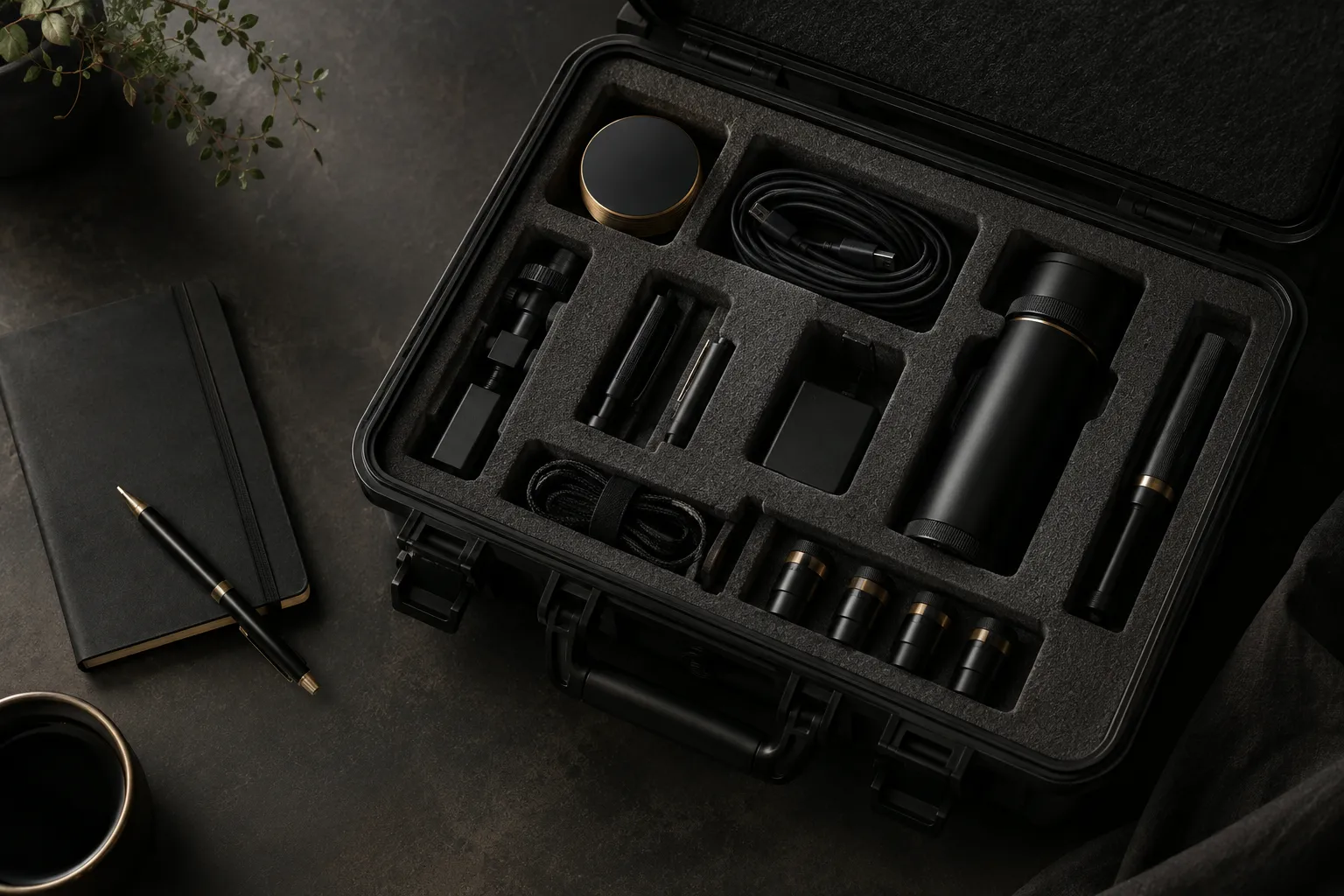
A professional post-break-in vehicle TSCM sweep conducted by a certified investigator operates on three detection layers that no consumer tool, app, or mechanic can replicate:
Layer 1 — RF Spectrum Analysis
A calibrated RF spectrum analyzer scans the full frequency range used by cellular GPS trackers — including 850 MHz, 1700 MHz, 1900 MHz, and 2100 MHz LTE bands — as well as Bluetooth (2.4 GHz) and LoRa (915 MHz) tracker protocols. Active devices that are transmitting location data are identified by their signal signature and frequency fingerprint. This layer catches real-time cellular GPS units reliably.
Layer 2 — Non-Linear Junction Detection (NLJD)
The NLJD broadcasts a swept RF signal and detects the harmonic return from semiconductor junctions in passive electronic devices — trackers that are powered off, in sleep mode between transmission bursts, or passively logging without any RF emission. This is the only method capable of detecting dormant or intermittently active trackers. ICUnit's NLJD protocol is derived from standards used by Canadian military and federal law enforcement for vehicle and facility counter-surveillance operations.
Layer 3 — Methodical Physical Inspection
A systematic physical inspection of all eight high-risk locations using borescopes for enclosed cavities and mirror wands for undercarriage access points. The physical layer catches devices that may be sufficiently shielded to reduce RF detection sensitivity — notably those in lead-lined magnetic mounts or positioned in RF shadow zones within the vehicle's frame.
For vehicles used in business operations, ICUnit's vehicle and office bundle sweep addresses the full operational footprint — vehicle, office, and personal devices — in a single coordinated engagement. Our recurring TSCM membership provides scheduled quarterly re-sweeps for clients operating in persistently elevated-risk environments, including executives, legal professionals, and commercial fleet operators. Pricing is custom — quoted privately after a confidential consultation.
Evidence Preservation for Insurance Claims & Police Investigation
A tracker discovered post-break-in is not only a security finding — it is physical evidence with significant value in insurance claims, civil litigation, and criminal prosecution. ICUnit's post-break-in sweep documentation package follows this sequence:
- Timestamped photographic record of each inspection zone, taken in sequence before any disturbance, formatted for police file submission and insurance adjuster review.
- Device identification sheet capturing make, model, serial number where visible, FCC or IC certification number, GPS and cellular band specifications, and estimated duration of placement based on device condition.
- Location diagram of the vehicle with the exact attachment point marked and described in relation to VIN-identified vehicle components — a standard insurance documentation requirement.
- Sweep methodology report documenting all equipment used, frequency ranges scanned, sweep duration, and technician credentials including PSISA licence number, TSCM certification, and MESA RF certification.
- Chain-of-custody log recording who handled the device, when, and what actions were taken at each stage. Required by OPP and TPS for formal device handoff to forensic analysis units.
For commercial fleet operators, this documentation package also supports insurer filings related to corporate assets surveilled or compromised following a break-in — a risk category that Ontario fleet insurers are increasingly scrutinizing in 2026 policy underwriting and renewal processes.
For a foundational overview of what TSCM sweep documentation involves and the standards applied, see our explainer on what TSCM is and how counter-surveillance inspections work.
Pricing for all post-break-in sweep and documentation services is custom — quoted privately after a confidential consultation reflecting scope, vehicle type, and response urgency.
Prevention: Hardening Your Vehicle Against Post-Break-In Tracking
After a sweep confirms your vehicle is clear, these operational hardening steps reduce your exposure to repeat targeting:
- OBD-II port blocker: A physical port lock prevents plug-in GPS dongle placement without tools. Available at automotive retailers across Ontario.
- Undercarriage protective coating: Anti-corrosion undercoating on frame rails and wheel wells reduces the metal surface available for magnetic tracker mounts, increasing installation difficulty and risk of discovery for would-be placers.
- Parking pattern variation: Avoid predictable overnight parking locations in high-risk postal codes. OPP data indicates the majority of tracker-enabled vehicle break-ins occur in residential driveways between late evening and early morning hours.
- AirTag detection active: Keep iPhone Find My proximity notifications enabled. Android users should run Tracker Detect weekly as a minimum cadence.
- Scheduled professional re-sweep: ICUnit's vehicle GPS sweep service is available as a standalone engagement or as part of our quarterly membership cycle. For clients in litigation, high-profile business disputes, or those who have experienced prior targeting, a scheduled sweep cadence is standard operational security practice. Pricing is custom — quoted privately after a confidential consultation.
Why Choose ICUnit for Vehicle Counter-Surveillance in Ontario?
Imperial Consulting Unit Inc. is the only Ontario TSCM provider combining the full credential and coordination stack required for post-break-in vehicle counter-surveillance that meets both evidentiary and operational standards:
- CAF Veteran leadership — military discipline and threat-assessment methodology applied to counter-surveillance operations
- PSISA-licensed Private Investigator — sweep reports are legally recognized in Ontario courts, accepted by insurance adjusters, and suitable for police file submission
- MESA RF Certified and TSCM Certified — the technical credential stack required for legitimate RF spectrum analysis and NLJD operation in Canada
- OPP and TPS coordination experience — direct working familiarity with police chain-of-custody requirements for tracker evidence in Ontario investigations
- Same-day emergency response — mobile across Ontario including Toronto, Ottawa, Hamilton, Kitchener-Waterloo, Barrie, Kingston, and province-wide
"ICUnit arrived the same day I called and found a hardwired tracker tucked inside the rear bumper bracket — something the attending officer had missed entirely. The chain-of-custody report they produced was exactly what my insurance adjuster and my lawyer both needed. Professional, discreet, and absolutely thorough."
— Fleet manager, 14-vehicle commercial fleet, Etobicoke, May 2026
Ontario Service Area: Post-Break-In Vehicle TSCM Sweeps
ICUnit is mobile across Ontario. We serve clients in Toronto (GTA), Ottawa, Hamilton, Kitchener-Waterloo, Barrie, Kingston, London, Niagara, Aurora, and across the province. Emergency same-day response is available. Pricing is custom — quoted privately after a confidential consultation.
Frequently Asked Questions: Post-Break-In GPS Tracker Detection in Ontario
What should I do immediately after finding a GPS tracker on my car in Ontario?
Do not remove the device. Photograph it in place with a timestamped photo, note the exact location, and contact OPP or TPS to file an amended police report. Then contact a PSISA-licensed TSCM provider such as ICUnit to conduct a formal sweep and produce a chain-of-custody evidence report. Removing a tracker before police and professional documentation may significantly compromise its evidentiary value for both criminal prosecution and insurance purposes.
Can I claim the cost of a professional vehicle sweep on my auto insurance after a break-in?
Many Ontario auto insurance policies treat a professional counter-surveillance sweep as part of the break-in claim — particularly when the sweep produces a documented finding such as a tracker discovery or a signed clean-sweep certificate. Provide your adjuster with the PSISA-licensed sweep report and chain-of-custody documentation. Some adjusters require the professional report before accepting tracker-related claims. Confirm specific coverage terms with your insurer, as policy terms vary across carriers and policies.
Are AirTags the only type of tracker used by Ontario theft rings during vehicle break-ins?
No. AirTags are the most commonly found Bluetooth-based tracker and generate Apple Find My proximity alerts on iPhones. However, Ontario's organized auto-theft rings are documented as also deploying hardwired cellular GPS units transmitting on LTE bands, passive data loggers with no live signal emission, and LoRa-based trackers that are completely invisible to consumer apps and pocket RF detectors. A calibrated professional RF spectrum sweep plus NLJD inspection is the only method that reliably detects all tracker types.
How long does a professional post-break-in vehicle TSCM sweep take?
A complete vehicle sweep — encompassing RF spectrum scan, NLJD sweep of all zones, and physical inspection of the 8 confirmed high-risk locations — takes approximately 2 to 3 hours for a standard passenger vehicle. Commercial vans, fleet vehicles, or vehicles with significant undercarriage modifications may require additional time. A full written report with chain-of-custody documentation is delivered on-site or within 24 hours of the sweep completion.
Does Criminal Code Section 184.1 apply if a GPS tracker was used to monitor my movements after a break-in?
Yes. Section 184.1 of the Criminal Code of Canada prohibits the unauthorized interception of private communications, and Canadian courts have extended this to systematic location and pattern-of-life data collection via tracker. If OPP or TPS determines the tracker was used for surveillance — rather than solely to facilitate vehicle theft — the perpetrator faces criminal charges under Section 184.1 in addition to Section 348 break-and-enter charges. Civil tort liability under Ontario privacy legislation may also apply as a separate civil cause of action, independent of any criminal conviction.
What is the difference between an RF sweep and a physical inspection for post-break-in tracker detection?
An RF sweep uses a calibrated spectrum analyzer to detect active signals from transmitting GPS and Bluetooth devices. A physical inspection uses borescopes and mirror wands to visually examine enclosed cavities and attachment points. Neither method alone provides complete coverage. ICUnit's professional protocol adds a third layer — NLJD detection of semiconductor junctions in passive or powered-off devices — ensuring no tracker type is missed regardless of its operational state during the sweep.
Stay Connected
Follow the ICUnit field log on LinkedIn for new Ontario vehicle security threat intelligence and counter-surveillance case updates, and read our Google reviews from past vehicle sweep and TSCM clients across the province.
Get Your Free Quote Today
If your vehicle was broken into and you need a professional counter-surveillance sweep with police-grade documentation, do not drive until you know your vehicle is clean. ICUnit's PSISA-licensed, TSCM-certified team is mobile across Ontario and available for same-day emergency response.
Call: 905-955-7689
Or request a confidential vehicle sweep consultation online — discreet, no-obligation, available province-wide.